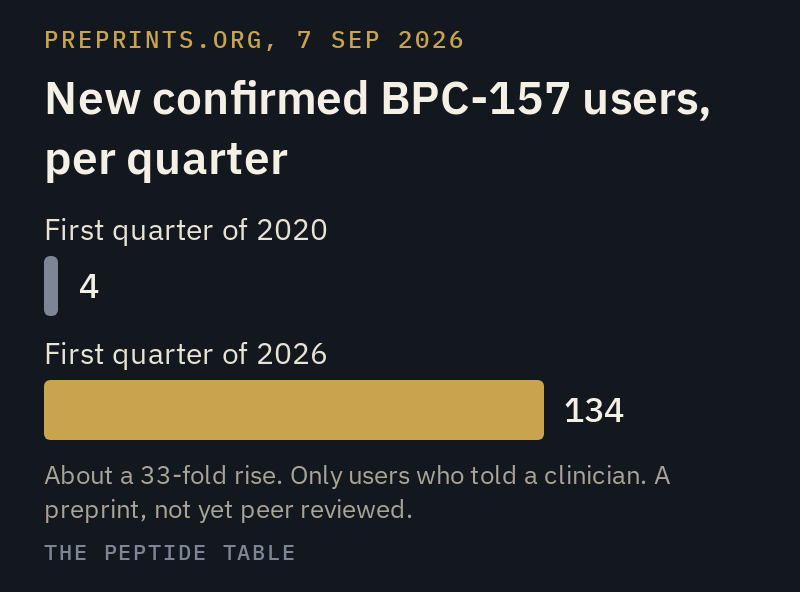
- A study read doctors' notes from 15.2 million patients and found 1,039 confirmed BPC-157 users.
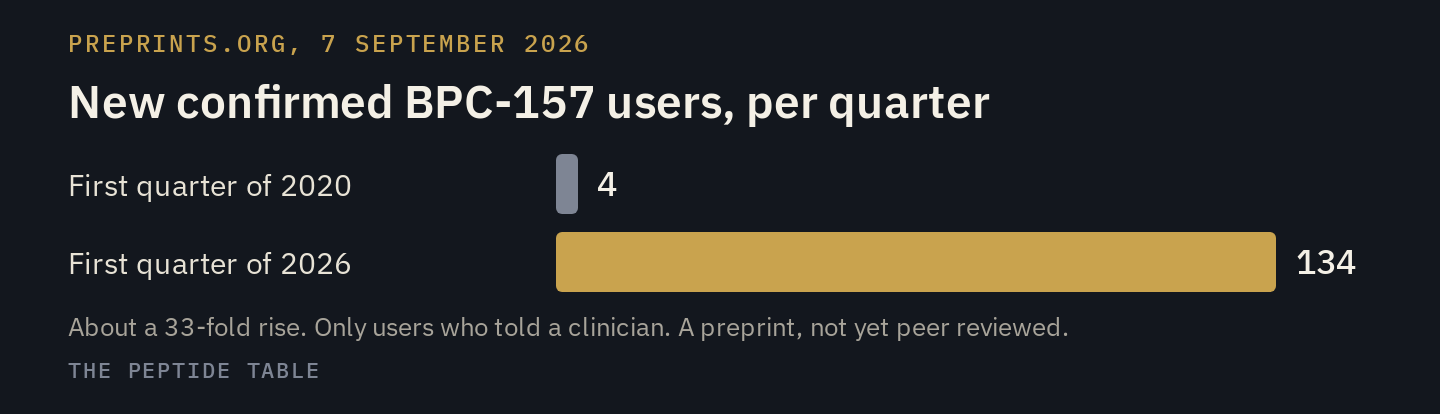
- New confirmed users rose from 4 in early 2020 to 134 in early 2026.
- BPC-157 has no drug code, so it does not show up on medication lists.
- 107 users took it for healing after surgery.
- The first trial of BPC-157 after shoulder surgery is "Not yet recruiting." See is BPC-157 safe?
How did researchers find BPC-157 users in medical records?
Researchers found BPC-157 users by reading the free text of doctors' notes, because the peptide leaves no other trace. BPC-157 "has no National Drug Code and no structured prescription record," the paper says.1
So it never lands on the list of medicines a hospital keeps. The authors expected its use "to be absent from structured medical records."1
They used an AI language model to read every note, and doctors checked samples of its work. On whether a patient took BPC-157, the model was right 87% of the time.1
Out of 15.2 million patients, 1,536 had a note that named BPC-157. Of those, 1,039, or 67.6%, had confirmed use.1
The users are changing. Men were 57% of new users in 2020 and 70% in 2026. Their mean age fell from 55 to 49.1 Our BPC-157 record lists what has been tested.
How long were patients on BPC-157 before a doctor knew?
In the study, patients were on BPC-157 for weeks to months before a doctor wrote it down. Among 80 users with a start date, use came first "by a mean of 60 days."1
That is only the patients who told someone. "There are certainly additional patients who have used BPC-157 but not reported it," the authors write.1
A surgeon's column in Healio put it in plainer words on 5 November 2026. "Chances are the patient has not told you or your staff."3
Most users had a single note confirming use. That was true for 603 of the 1,039.1
Why does BPC-157 matter before surgery?
BPC-157 matters before surgery because many users take it for the very injuries surgeons repair. The shoulder was the most common injury site, and rotator cuff problems led the list.1
| Reason for use, from the notes | Users | Share of all 1,039 |
|---|---|---|
| Pain | 338 | 33% |
| Stomach and gut problems | 148 | 14% |
| A prior injury | 118 | 11% |
| Healing after surgery | 107 | 10% |
- Users
- 338
- Share of all 1,039
- 33%
- Users
- 148
- Share of all 1,039
- 14%
- Users
- 118
- Share of all 1,039
- 11%
- Users
- 107
- Share of all 1,039
- 10%
Surgery itself was in the notes of 131 users.1
Some users stopped. Of 129 who quit, 59 did so on a clinician's advice. Another 24 stopped because of side effects.1
The Healio column names the risk it sees. It describes "an unknown dose of an unverified substance of uncertain sterility." It says this goes into "an operation in which infection is among the most feared complications."3
"No data define a safe hold period," the column adds.3
Where did patients get their BPC-157?
Patients got BPC-157 most often from compounding pharmacies and gray-market vendors, among the few whose source was written down. The notes gave a source for only 205 of the 1,039 users.1
| Source, where noted | Share of the 205 |
|---|---|
| Compounding pharmacy | 36% |
| Gray-market peptide vendor | 35% |
| Wellness spa or weight clinic | 11% |
- Compounding pharmacy
- 36%
- Gray-market peptide vendor
- 35%
- Wellness spa or weight clinic
- 11%
Half of all users took something else with it. Testosterone came first, at 17.0%. TB-500 was in 12.9%.1
Has BPC-157 been tested in people after surgery?
BPC-157 has not been tested in a finished trial after surgery. The first such trial is listed on ClinicalTrials.gov as "Not yet recruiting."23
Its own record says BPC-157 "has not yet been studied in formal human clinical trials."2
The trial plans to compare BPC-157 with salt water after rotator cuff repair. Its summary says 20 patients. Its enrollment line says 30. Its estimated start is 1 January 2027.2
Until then, the human record is thin. The preprint lists "a retrospective knee-pain series, a 12-patient interstitial-cystitis pilot and a two-participant intravenous safety pilot."1 Our page on whether BPC-157 is legal covers where it stands.
What nobody has shown
- Whether BPC-157 changes infection or healing after surgery. No finished trial tests it.
- How many people take it and never tell a doctor. The study counts only those who did.
- What was in the vials. The notes do not test products.
- How many side effects went unwritten. The authors say they are "likely subject to under-reporting."1
The other side
Many users said they felt better. Of 354 with a written response, 79% reported improvement and 5% reported worse symptoms.1 The authors say these reports "cannot establish efficacy." Side effects were rare in the notes: neuropsychiatric events in 1.4% and gut events in 1.3%.1 The study has no comparison group. Its authors work for the company that runs the records network, and say no outside funding was received.1
What would change this
- Results from the rotator cuff trial, NCT07803250 on ClinicalTrials.gov (opens in new tab).
- A peer-reviewed version of the preprint.
- A study of surgical infections in BPC-157 users against non-users.
Three questions to ask next
Last checked: 7 November 2026.
- [1] Rising Use of Unapproved BPC-157 (Wolverine Peptide) and Associated Patient-Reported Outcomes Curated from Clinical Notes (opens in new tab). Venkatakrishnan AJ, Marwaha A, Gregg CJ, and others, Preprints.org, version 1, posted 7 September 2026, doi 10.20944/preprints202609.0501.v1Back to text (first mention of source 1)
- [2] Impact of BPC-157 on Recovery Following Rotator Cuff Repair Surgery (opens in new tab). ClinicalTrials.gov, NCT07803250, sponsor University of Arkansas, first posted 3 September 2026Back to text (first mention of source 2)
- [3] Patients are injecting peptides: Ask before you operate (opens in new tab). Romeo AA, Healio, Orthopedics Today commentary, 5 November 2026Back to text (first mention of source 3)