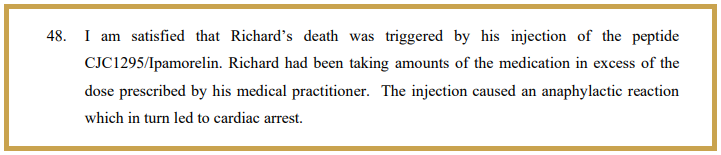
- Coroner David Ryan found the death "was triggered by his injection of the peptide CJC1295/Ipamorelin."
- The finding records warning signs in the days before: flushing all over his body, then chest tightness.
- An expert told regulators there is "insufficient evidence" that the peptide is safe, effective or beneficial for human use.
- Australia's regulator had three other reports of anaphylaxis with the same peptide pair.
- The coroner asked the regulator to consider a ban for human use. See our CJC-1295 record.
What did the coroner find about CJC-1295 and ipamorelin?
The coroner found that a shot of CJC-1295 and ipamorelin set off the reaction that killed Richard Norton. The finding reads: "The injection caused an anaphylactic reaction which in turn led to cardiac arrest."1
Anaphylaxis is a severe allergic reaction. The pathologist found evidence of it at autopsy.1
The cause of death is listed in three parts. First, "Complications of an out of hospital cardiac arrest". Then "Anaphylaxis". Asthma and a thickened heart muscle are listed as contributing.1
He collapsed at home on 28 March 2025 and died at the Alfred Hospital in Melbourne two days later.1
The finding also records that he "had been taking amounts of the medication in excess of the dose prescribed by his medical practitioner."1
Were there warning signs before the collapse?
There were warning signs before the collapse, according to the hospital records the coroner quotes. Reactions started with his first shot of CJC-1295 and ipamorelin.1
The records describe "initially local redness and swelling, and subsequently whole of body flushing for the last few days".1
On the morning of the day he collapsed, the records say "he had whole of body flushing, chest tightness, and shortness of breath". Those symptoms eased after he used his asthma inhaler.1
That evening, he took another shot. He then complained of feeling hot and flushed, and collapsed.1
His consent form had named the risk. "One of the risks identified for the peptide CJC1295 & Ipamorelin was anaphylaxis," the finding says.1
| Date, as the finding records it | What happened |
|---|---|
| 11 March 2025 | First visit about peptide therapy |
| 15 March 2025 | Consent form lists anaphylaxis as a risk |
| 19 March 2025 | Prescribed CJC-1295 and ipamorelin |
| 25 March 2025 | Says he feels good |
| 28 March, morning | Flushing, chest tightness, short of breath |
| 28 March, about 9 pm | Another shot. He collapses |
| 30 March 2025 | Dies in hospital |
| 28 October 2026 | The coroner's finding |
- 11 March 2025
- First visit about peptide therapy
- 15 March 2025
- Consent form lists anaphylaxis as a risk
- 19 March 2025
- Prescribed CJC-1295 and ipamorelin
- 25 March 2025
- Says he feels good
- 28 March, morning
- Flushing, chest tightness, short of breath
- 28 March, about 9 pm
- Another shot. He collapses
- 30 March 2025
- Dies in hospital
- 28 October 2026
- The coroner's finding
Is CJC-1295 with ipamorelin approved?
CJC-1295 with ipamorelin is not approved in Australia, the finding says. It is an "unapproved" therapeutic good there.1

The pathologist's evidence goes wider. Peptides like these "are not approved by the TGA or any global regulatory authority for human use."1
The pathologist went further: "The toxicology is largely unknown, but they have potential side effects including carcinogenicity, endocrine and cardiovascular effects."1
An independent expert for Australia's medical board said the same of this pair. He found "insufficient evidence that CJC1295/Ipamorelin is safe, effective or beneficial for human use."1
His list of side effects he called likely ends with "in rare cases allergic reaction including anaphylaxis."1 Our ipamorelin record lists what human trials exist.
Has anyone else reacted badly to CJC-1295 and ipamorelin?
Others have reported bad reactions to CJC-1295 and ipamorelin in Australia. The regulator, the TGA, told the court it had six reports of anaphylaxis or hypersensitivity. They came from people using three peptide products.1
| Reports to the TGA, as the finding records them | Count |
|---|---|
| Anaphylaxis or hypersensitivity, three peptide products | 6 |
| Of those, anaphylaxis with CJC-1295 and ipamorelin | 3 |
- Anaphylaxis or hypersensitivity, three peptide products
- 6
- Of those, anaphylaxis with CJC-1295 and ipamorelin
- 3
Those counts do not include this death.1 The others named are BPC-157 or thymosin beta-4, and TB-500. See our TB-500 record and Is BPC-157 safe?.
A report records a suspicion. It does not prove the peptide caused the harm.
What did the coroner ask regulators to do about CJC-1295 and ipamorelin?
The coroner asked Australia's regulator to consider banning CJC-1295 and ipamorelin for human use. He named Schedule 10, which is titled "Substances of such danger to health as to warrant prohibition of supply and use."1
He wrote: "I am not satisfied that it is appropriate for them to be available to be prescribed by medical practitioners."1
He called their risks "as yet not fully known."1 A ban could still allow clinical trials, he added.1
Under the court's rules, a body that gets a recommendation "must respond, in writing, within three months."2 The TGA's answer is due by late January 2027, by our count.
What nobody has shown
- What was in his vial. The post-mortem tests could not detect the specific peptides.1
- How common anaphylaxis is with this peptide pair. Nobody counts every case.
- Any published controlled trial that shows CJC-1295 with ipamorelin is safe in people. The expert found "insufficient evidence."
- Whether the same could happen with the same pair bought anywhere else. This finding covers one man and one supply.
The other side
This was a prescription from a doctor, after a medical history and blood tests.1 An expert for the medical board found the clinical care "was at a standard reasonably expected." He faulted the records.1
He had asthma and a thickened heart muscle, and the pathologist said both could have contributed.1 He was also taking more than he was prescribed.1
Hours before he collapsed, he told a nurse of better sleep and less pain, with no side effects.1 The coroner also wrote that in time, specific uses may be found "which justify the associated risks."1
What would change this
- A controlled trial in people that measures harm, including allergic reactions.
- A lab test of what is inside vials sold under these names.
- The TGA's written response to the coroner.
Three questions to ask next
Last checked: 31 October 2026.
- [1] Coroners Court of Victoria (opens in new tab). Finding into death without inquest, COR 2025 001710, Coroner David Ryan, 28 October 2026 (13 pages)Back to text (first mention of source 1)
- [2] Findings (opens in new tab). Coroners Court of Victoria, web page with the list of findings and the rules on recommendations, read 31 October 2026Back to text (first mention of source 2)