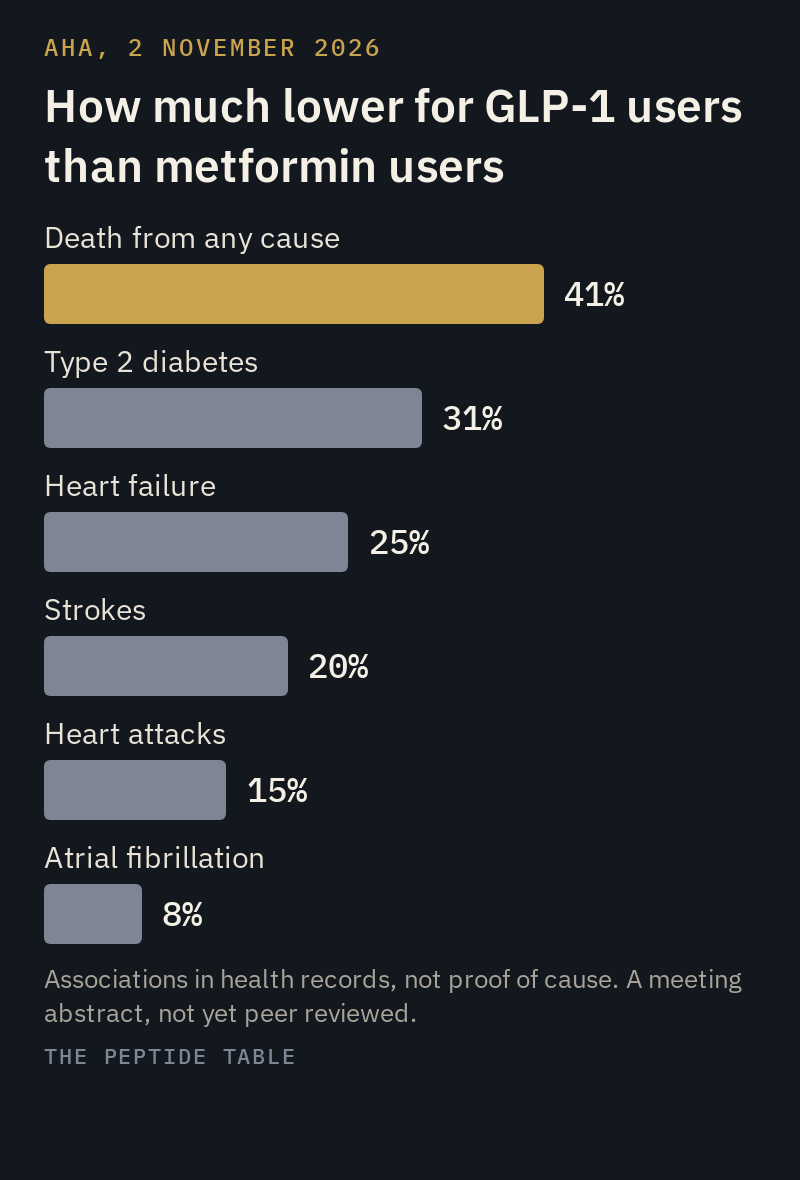
- GLP-1 users in the records did better than metformin users on every count the release lists.
- The study compared health records. It did not assign anyone a drug.
- It could not see whether people took their medicine, or how much.
- One heart expert says weight loss may explain the gains.
- The drugs studied include semaglutide and tirzepatide. See the semaglutide record.
What did the GLP-1 vs metformin study find?
The GLP-1 vs metformin study found better results for GLP-1 users on every measure the release names. Here are the numbers, against people taking metformin.1
| Outcome, GLP-1 users against metformin users | Result |
|---|---|
| Blood sugar back to normal | 1.5 times higher chance |
| Developing Type 2 diabetes | 31% lower risk |
| Death from any cause | 41% lower risk |
| Heart attacks | 15% fewer |
| Strokes | 20% fewer |
| Heart failure | 25% fewer |
| Atrial fibrillation | 8% fewer |
- Blood sugar back to normal
- 1.5 times higher chance
- Developing Type 2 diabetes
- 31% lower risk
- Death from any cause
- 41% lower risk
- Heart attacks
- 15% fewer
- Strokes
- 20% fewer
- Heart failure
- 25% fewer
- Atrial fibrillation
- 8% fewer
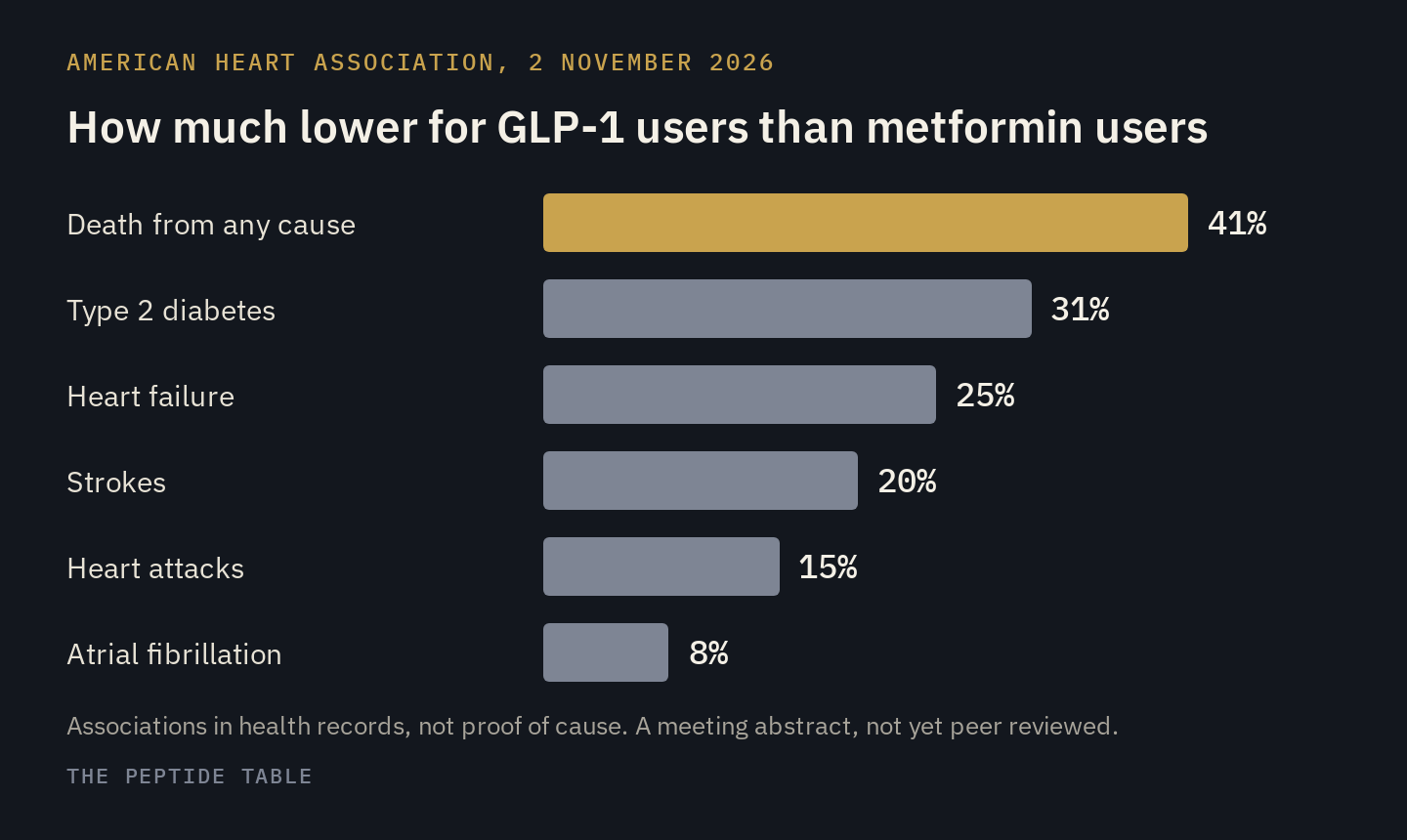
The study followed people for about 3 years on average. The release's highlights speak of "a 5-year period" for the death finding.1
Who was in the GLP-1 and metformin study?
The GLP-1 and metformin study used records of 256,492 adults with prediabetes and obesity. Their average age was 52, and 76% were women.1
The records came from a network of 104 institutions, from 2010 to 2023. About half took a GLP-1 drug. The other half took metformin.1
The GLP-1 drugs were semaglutide, tirzepatide, liraglutide or dulaglutide. The study grouped them together.1 Our tirzepatide record shows its trials.
Prediabetes is common. Nearly 40% of U.S. adults have it, the release says. It moves on to Type 2 diabetes for "up to 10%" of them each year.1
The drugs are already common. About 1 in 10 U.S. adults may take a GLP-1 drug, the release says. It cites a 2026 survey of more than 2,800 hospitals and health systems.1
Can a records study prove GLP-1s save lives?
A records study cannot prove GLP-1s save lives, and this one says so. "The study is observational and, therefore, cannot prove a cause-and-effect relationship."1
The release lists three more limits.1
- Patients and outcomes were found "through diagnosis codes, which can be incomplete."
- The researchers "relied on prescription records." So "how consistently patients took medication or at what dose is not reflected."
- The four GLP-1 drugs were pooled, so "individual differences between agents were not considered."
The researchers matched patients by age, health problems and other medicines. The release says this "helped ensure" differences came from the drug.1 Matching can only use what the records hold.
Why did GLP-1 users do better than metformin users?
GLP-1 users may have done better because they lost weight, one heart expert says. That is his view, not a finding of the study. Robert Eckel, a past volunteer president of the American Heart Association, was not involved in the study.1
"The benefits noted in this study likely relates to the patients losing weight, which is known to help prevent Type 2 diabetes," he said.1
The study author, Vinicius de Sousa Barzon Serra of the Mayo Clinic, kept metformin in the picture. "Metformin is still a first-line treatment choice," he said. "It is safe, inexpensive and has a long track record."1
"This is less about replacing one medication with another," Serra added.1
Eckel added a line about money. "However, costs and access to these medications are important factors."1
Is the GLP-1 vs metformin study peer reviewed?
The GLP-1 vs metformin study is not peer reviewed yet, because it is a short abstract shown at a meeting. The release says abstracts at the meeting "are not peer-reviewed."1
It calls the findings "preliminary until published as a full manuscript in a peer-reviewed scientific journal."1
So outside experts have not yet checked the methods line by line. The numbers in this article come from a news release about a short abstract. We did not open the abstract itself.
A big headline number can travel far ahead of its limits. Our article on retatrutide against Ozempic shows another one, and what came with it.
What nobody has shown
- That GLP-1 drugs cause the lower death risk. The study found a link.
- Which of the four drugs did best. They were pooled.
- What doses people took, or whether they took them.
- What side effects came with the gains. The release does not report them.
- Whether the results hold the same for men. About three in four people in the study were women, by the release's 76%.
The other side
The study is large, with more than 250,000 people. The release calls it "independent."1 Its results point the same way across diabetes, heart attacks, strokes and heart failure. The researchers matched patients to make the groups alike. The release says Eckel found the results not surprising.1 Serra says the work "may add to the case for considering GLP-1 medications earlier for certain patients."1
What would change this
- The full paper, after peer review.
- A trial that assigns people at random to a GLP-1 or metformin.
- Results split by drug and by dose.
Three questions to ask next
Last checked: 7 November 2026.
- [1] GLP-1 meds linked to lower diabetes, heart risks than standard diabetes prevention med (opens in new tab). American Heart Association, news release on Scientific Sessions 2026 abstract MDP1524, published 2 November 2026Back to text (first mention of source 1)