- Hair loss is on the label's list of the most common Zepbound side effects.
- In the trials, 1 in 100 people on placebo lost hair. On Zepbound it was 4 or 5 in 100.
- Women reported it far more than men: 7.1% against 0.5% on Zepbound.
- The label ties hair loss to weight loss, but gives no time course.
- Zepbound's drug is tirzepatide, the same drug as Mounjaro. See our tirzepatide record.
Does Zepbound cause hair loss?
Zepbound's label lists hair loss as a side effect seen more often on the drug than on placebo. The label lists it with the reactions "reported in ≥5% of patients treated with ZEPBOUND."1
The full list, in the label's order: "nausea, diarrhea, vomiting, constipation, abdominal pain, dyspepsia, injection site reactions, fatigue, hypersensitivity reactions, eructation, hair loss, gastroesophageal reflux disease."1
The Medication Guide for patients says it in plainer words. "The most common side effects of ZEPBOUND include," it begins. "Hair loss" is the eleventh item, right before heartburn.1
Those rates come from trials. Trial rates "may not reflect the rates observed in practice," the label says.1
How common is hair loss on Zepbound?
Hair loss on Zepbound came to 4 or 5 in 100 people in the label's main trials. On placebo it was 1 in 100.1
The label pools two trials. They "included 2,519 adult patients with obesity or overweight treated with ZEPBOUND for up to 72 weeks."1 The placebo group had 958 people.1
| In the two pooled trials | Hair loss |
|---|---|
| Placebo | 1% |
| Zepbound, first group | 5% |
| Zepbound, second group | 4% |
| Zepbound, third group | 5% |
- Placebo
- 1%
- Zepbound, first group
- 5%
- Zepbound, second group
- 4%
- Zepbound, third group
- 5%
The three Zepbound groups differ only in the amount of drug. The label does not show more hair loss in the highest group. Two groups were at 5%, one at 4%.1
That makes hair loss about as common as fatigue, at 5 to 7%, in the same table.1
Is Zepbound hair loss worse for women?
Zepbound hair loss was far more common in women, by the label's own count. In the two pooled trials, 7.1% of women on Zepbound reported hair loss, against 0.5% of men.2
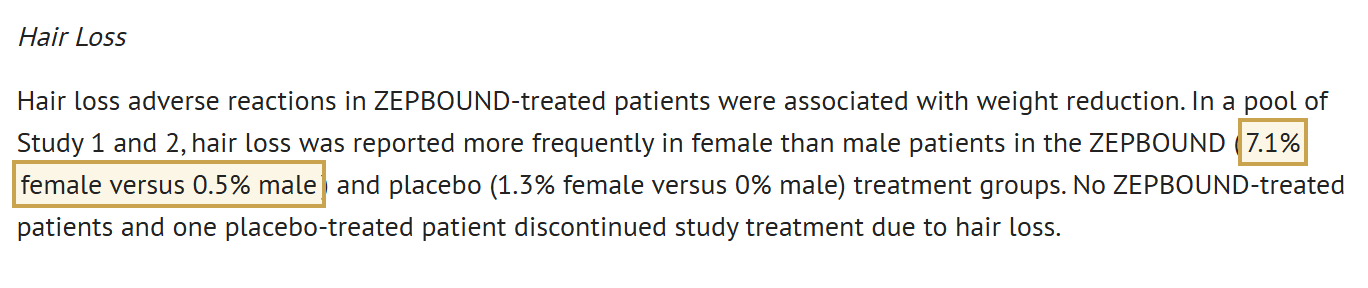
On placebo it was 1.3% of women and no men.2 The trials were mostly women. In the pooled trials, "37% were male."1 So close to two in three were not.
The label ties the hair loss to weight. "Hair loss adverse reactions in ZEPBOUND-treated patients were associated with weight reduction," it says.2 It does not say how much weight, or how fast.
The average age was 47.1 The label gives no breakdown of hair loss by age.
Does hair grow back after Zepbound?
Whether hair grows back after Zepbound is a question the label leaves open. We searched its text for every line on hair, its hair loss paragraph included. None of them says.2
There is no line on when hair loss started in the trials. There is none on how long it lasted, or on whether people who stopped the drug got their hair back.1
The trials did have an end. They included a four-week "off drug follow-up period."1 The label prints no hair result from it.
What the Medication Guide does say is short. "Talk to your healthcare provider if you have any side effect that bothers you or that does not go away."1 Then it adds: "These are not all the possible side effects of ZEPBOUND."1
Why did people quit Zepbound in the trials?
People quit Zepbound in the trials for side effects more often than on placebo. The label gives the share who stopped for good "as a result of adverse reactions."1
| Stopped for good over side effects | Share |
|---|---|
| Placebo | 3.4% |
| Zepbound, the three groups | 4.8%, 6.3% and 6.7% |
- Placebo
- 3.4%
- Zepbound, the three groups
- 4.8%, 6.3% and 6.7%
Hair loss was not one of the reasons. "No ZEPBOUND-treated patients and one placebo-treated patient discontinued study treatment due to hair loss," the label says.2 It does count stomach and gut side effects. They hit 56% of people in each Zepbound group, against 30% on placebo.1
In a third trial, the gap was wider. "10% of ZEPBOUND-treated patients and 2% of placebo-treated patients discontinued drug due to adverse reactions."1 Another trial of the same drug, for another reason, is in Mounjaro and birth control.
What nobody has shown
- How long Zepbound hair loss lasts, by the label.
- Whether the hair grew back once people stopped.
- How much weight loss goes with hair loss. The label links the two, with no numbers.2
- What a copy of tirzepatide sold outside the label does. See is compounded tirzepatide the same as Zepbound.
The other side
Hair loss is uncommon on Zepbound by the label's count: 95 or 96 in 100 people in the trials did not report it.1 One in 100 on placebo lost hair too, so some loss happens without the drug. Nobody on Zepbound in those two trials quit over it.2 The rate did not climb in the group that got the most drug.1 And the label lists it openly, on its first page and in the patient guide. Nothing here is hidden. It is unfinished.1
What would change this
- A label update, or a study, that follows hair loss over time.
- Hair loss counts by how much weight people lost.
- Results from the four weeks off the drug.
Three questions to ask next
Last checked: 15 November 2026.
- [1] Eli Lilly and Company (opens in new tab). Zepbound (tirzepatide), prescribing information and Medication Guide, version effective 28 August 2026 (set ID 487cd7e7-434c-4925-99fa-aa80b1cc776b), as held in the FDA's openFDA drug label data. Highlights; section 6.1, Clinical Trials Experience; Medication GuideBack to text (first mention of source 1)
- [2] US National Library of Medicine, DailyMed (opens in new tab). Zepbound (tirzepatide) label, SPL version 40, published 2 September 2026 (effective 28 August 2026). Section 6.1, "Hair Loss"Back to text (first mention of source 2)