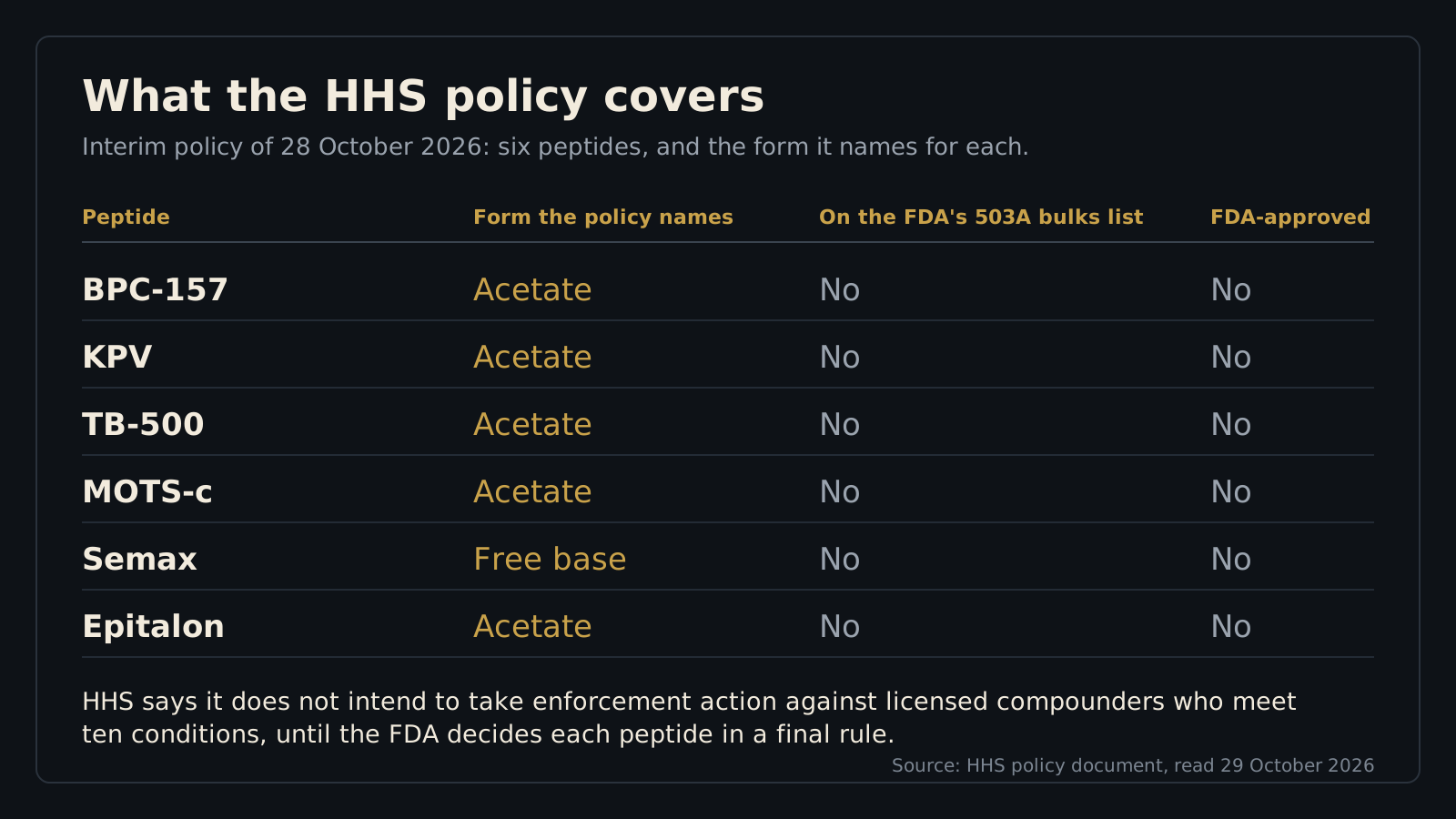
- HHS published an interim policy on 28 October 2026. It covers BPC-157, TB-500, KPV, MOTS-c, Epitalon and Semax.1
- HHS says it does not intend to take enforcement action against licensed pharmacies and physicians who compound them when ten conditions are met.1
- The policy approves nothing. It says compounded drugs are not FDA-approved and the FDA does not review their safety, effectiveness or quality before they are marketed.1
- The FDA's own scientists had recommended against listing all seven peptides the July panel reviewed. The panel backed six.3
- The policy lasts until a final FDA rule decides each peptide. HHS may revisit it if a safety signal or quality issue appears.1
What is the HHS peptide compounding policy?
The HHS peptide compounding policy is an interim enforcement policy. HHS published it on 28 October 2026.12
Its title is "HHS Enforcement Discretion Policy Regarding 503A Compounding Using Certain Peptide Bulk Drug Substances".1
In plain words, HHS says it does not intend to take enforcement action against some pharmacies and physicians. It does not change a law. It does not approve a drug.1
On 14 October 2026 a document with a similar title, "Interim Access Policy for Compounding Using Certain Peptides", reached the White House regulatory office.6 We have not seen a record that ties the two documents together.
Which peptides does the HHS policy cover?
Appendix A of the policy lists six peptides. Appendix B names the form of each one. The table also shows the use the FDA reviewed for each at its July meeting.15
| Peptide | Form the policy names | Use the FDA reviewed |
|---|---|---|
| BPC-157 | Acetate | Ulcerative colitis |
| KPV | Acetate | Wound healing and inflammatory conditions |
| TB-500 | Acetate | Wound healing |
| MOTS-c | Acetate | Obesity and osteoporosis |
| Semax | Free base | Cerebral ischemia, migraine and trigeminal neuralgia |
| Epitalon | Acetate | Insomnia |
- Form the policy names
- Acetate
- Use the FDA reviewed
- Ulcerative colitis
- Form the policy names
- Acetate
- Use the FDA reviewed
- Wound healing and inflammatory conditions
- Form the policy names
- Acetate
- Use the FDA reviewed
- Wound healing
- Form the policy names
- Acetate
- Use the FDA reviewed
- Obesity and osteoporosis
- Form the policy names
- Free base
- Use the FDA reviewed
- Cerebral ischemia, migraine and trigeminal neuralgia
- Form the policy names
- Acetate
- Use the FDA reviewed
- Insomnia
Emideltide, the seventh peptide the panel reviewed, is not in the policy. The panel did not back it.13
Pentadeca arginate is not in the policy either.1
What conditions does the policy set?
HHS lists ten conditions. A compounder has to meet all of them.1
- The peptide is one of the six in Appendix A.
- The ingredient matches the identity HHS describes in Appendix B, and is used only in the ways the policy allows.
- The ingredient comes from a facility registered with the FDA and has a valid certificate of analysis.
- The original maker is registered with the FDA and meets manufacturing standards.
- The compounder reports products made, serious adverse events and quality problems to the FDA and to the states.
- The label says "This is a compounded drug product. Not for resale."
- The product holds only one active ingredient from the list.
- Some forms need extra proof that the body can use them. The policy sets that out.
- The only device packed with the product is one the FDA has cleared.
- The product meets the rest of the law, including a prescription for a named patient and clean making conditions.
The policy says it aims to discourage "continued, widespread use of certain research-use-only peptides supplied by foreign manufacturers".1 It requires an FDA-registered maker and a certificate of analysis. A research use only label supplies neither. Our page on how to tell if a peptide vendor is legitimate covers the certificate.
Does the policy make these peptides safe or approved?
No. The policy says compounded drugs are not FDA-approved, so the FDA does not review their safety, effectiveness or quality before they are marketed.1 It adds that compounded drugs may pose risks to patients.1
The FDA's own reviewers found little human evidence. For BPC-157 they counted five small studies. Their briefing document says the criteria "weigh against placing both BPC-157 (free base) and BPC-157 acetate on the list".4
For KPV, the FDA's reviewers found no information on use in people.7
The AP reports that most FDA scientific staff opposed the plan and had limited input in drafting it, citing six people familiar with its development.2
Is this the same as adding the peptides to the FDA's compounding list?
No. The policy applies while the FDA decides each peptide in rulemaking on the 503A bulks list.1 None of the six is on that list today.1
The AP reports that HHS first wanted the FDA to draft a regulation that would put these peptides on a list for compounding. The published policy is a step back from that plan, according to two people involved.2
The policy says all six sat in the FDA's Category 2 list of safety-risk substances until 22 April 2026. It adds that neither going in nor coming out changed their status under section 503A.1
HHS may revisit the policy, in whole or in part, if a safety signal or product quality issue arises.1
What nobody has shown
The other side
HHS gives its reasons. It says the policy gives patients a more controlled alternative to research-use-only peptides from foreign makers.1
The advisory committee did vote to recommend all six for the compounding list, by narrow margins. The FDA's page says the agency "generally follows the recommendations" of its panels.5
The FDA staff's case against these peptides is about missing studies and possible risks. A missing study is a gap in what is known, in both directions.
What would change this
- A proposed or final FDA rule that adds a peptide to the 503A bulks list or leaves it off.
- HHS narrowing or withdrawing the policy.
- A published human trial of BPC-157 for the use the FDA reviewed.
Three questions to ask next
Last checked: 29 October 2026.
- [1] HHS Enforcement Discretion Policy Regarding 503A Compounding Using Certain Peptide Bulk Drug Substances (opens in new tab). US Department of Health and Human Services. Read on 29 October 2026Back to text (first mention of source 1)
- [2] AP report: FDA scientists opposed the Trump administration's move to ease peptides access (opens in new tab). Associated Press, 28 October 2026Back to text (first mention of source 2)
- [3] FDA Panel Backs 6 Peptides for Compounding (opens in new tab). Steinzor P. AJMC, 31 July 2026Back to text (first mention of source 3)
- [4] FDA Briefing Document for BPC-157-Related Bulk Drug Substances (opens in new tab). US Food and Drug Administration, Pharmacy Compounding Advisory Committee, July 23-24, 2026. Dated 11 May 2026Back to text (first mention of source 4)
- [5] July 23-24, 2026: Meeting of the Pharmacy Compounding Advisory Committee (opens in new tab). US Food and Drug Administration. Read on 29 October 2026Back to text (first mention of source 5)
- [6] Executive Order Submissions Under Review (opens in new tab). Office of Information and Regulatory Affairs, Office of Management and Budget, entry for HHS-FDA, "Interim Access Policy for Compounding Using Certain Peptides", RIN 0910-ZD94, received 10/14/2026. Read on 18 October 2026Back to text (first mention of source 6)
- [7] FDA Briefing Document for KPV-Related Bulk Drug Substances (opens in new tab). US Food and Drug Administration, Pharmacy Compounding Advisory Committee, July 23-24, 2026. Dated 12 May 2026Back to text (first mention of source 7)